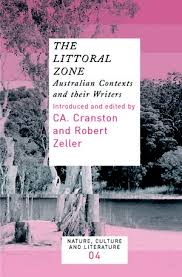
The Littoral Zone:
Australian Contexts and their Writers.
CA. Cranston & Robert Zeller (editors and contributors). Rodopi Press, Amsterdam and New York, 2007 (319 pp) ISBN 9789042022188
‘In this, the first collection of ecocritical essays devoted to Australian contexts and their writers, Australian and US scholars explore the transliteration of land and sea through the works of Australian authors and through their experiences. The collection features Australian environments—rainforest, deserts, mountains, coast, islands, Antarctica—by Australian and US scholars, including Bruce Bennett, Tony Hughes-d’Aeth, Mitchell Rolls, Mark Tredinnick, Veronica Brady, Kate Rigby, Ruth Blair, Elizabeth Leane, Tom Lynch, CA. Cranston, Robert Zeller’. (Source: back cover)
Sample reviews of The Littoral Zone:
EXTRACT: ‘The Littoral Zone is unique out of the texts reviewed in this essay in that it allows the land to structure the writing, where the chapters are arranged geographically, looking at a different part of the landscape of Australia, from the coastal plain of Western Australia to limestone plains of Queensland. This shifts the primacy from the writer, or even the literature, to the land itself. The ideal in this approach is to perceive a reciprocal relationship between the land and the literature. Hughe D’Aeth’s chapter on the wheatbelt of Western Australia exemplifies how the shifts in farming practices altered Australian poetry, and how this occurred in part from a necessity to endorse wheat farming. It would be interesting, and I think useful, to reconstruct The Ecopoetry Anthology from this perspective, grouping the texts by geography or the combination of geography and chronology.‘
Caitlin Maling, ”Planting Roots: A Survey of Introductions to Ecopoetry and Ecocriticism’ The Cordite Poetry Review (2013).
EXTRACT: ‘There are a number of reasons why this is an important collection of essays. First, it challenges the hegemonic status of the United States as the locus of contemporary ‘nature writing’. Second, while continuing the interrogation of Aboriginal decimation and displacement consequent on settler-invasion, it extends that ethical inquiry to encompass the ‘extra-human world’. Third, in explaining the extent and nature of the Australian littoral, it posits more complex ‘zones’ of the Australian imaginary than the often discretely represented bush, city and beach; and finally, it draws our attention to both new and neglected works and writers (as well as to poems and prose pieces by more established ones) in order to suggest a much larger and stronger tradition of Australian nature writing than has generally been acknowledged.‘
Helen Tiffin, ‘Green or Greed?’ Australian Literary Studies, Vol. 25, no. 2, 2010
URL: https://www.australianliterarystudies.com.au/issues/volume-25-no-2
EXTRACT: ‘Ecocritics seeking an abstracted nature – a wilderness without humans or society – will be disappointed by Australia’s offerings. However, as this collection shows, there is a distinctive way to appreciate Australian places and the writing about them, and the first thing we need to do is rid ourselves of the expectations of elsewhere. The writers in the collection each approach their ecocriticism differently. Perhaps not unexpectedly, north American authors, Robert Zeller and Tom Lynch, focus closely on the literature; they help us read the literature of North Queensland and Central Australia as bioregional writing. CA. Cranston, whose ‘formative geographies include Egypt, Ceylon, Hong Kong, the American Southwest and twenty years on a temperate island in the Southern Ocean’ (p. 292), looks at the Island as a maker of people and literature. She takes insularity seriously through the close scrutiny of particular small islands. Cranston’s places are about an ecology of mind, her nissology (island-study) both psychological and aesthetic.‘
Libby Robin, Ecohumanities Corner, Issue 42, Aug 2007 URL: https://australianhumanitiesreview.org/2007/08/01/the-problematic-pastoral-ecocriticism-in-australia-a-review-of-ca-cranston-and-robert-zeller-eds-the-littoral-zone-australian-contexts-and-their-writers-australia/
EXTRACT: ‘While wanting if I can to avoid the reviewer’s error of over-enthusiasm, I would like to say at once how much pleasure this book gave me. After years of trekking through the deconstructive wastelands, it was a relief to rest in such green pastures, where a tree is seen as a tree, and not just a text. In fact, the essays collected here freshly combine two life-enhancing activities that the literary academy since the eighties has underplayed to its cost—those of reading nature in depth and literature in abundance. Furthermore, the present environment crisis, ecocriticisms, exemplified here, is the more politically constructive work that literary scholars can aspire to.‘ (p.152)
Cheryl Taylor, ‘ JASAL, Vol. 8, 2008 URL:https://openjournals.library.sydney.edu.au/JASAL/article/view/9741
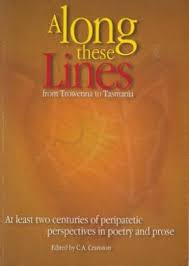
Along these Lines: From Trowenna to Tasmania. At least two centuries of peripatetic perspectives in poetry and prose.
(Launceston: Cornford Press (442 pp), published June 2000.
Collected, Compiled, Edited, Introduced, and Annotated by CA. Cranston.
This historical, geographical, and literary place-based anthology gathers together the stories, poetry, musical compositions and gossip that exists alongside the roads that travel Tasmania and some of its islands. Excerpts include those from well-known visitors to the island, such as Charles Darwin, Anthony Trollope, Mark Twain, Joshua Slocum, Mrs Humphrey Ward, Hal Porter, Germaine Greer, Louis Nowra, Bryce Courtenay, Roger MacDonald Robert Drewe, and on. Broadly local talents include Caroline Leakey, Errol Flynn, Katharine Susannah Prichard, Peter Conrad, Peter Sculthorpe, C.J. Koch, Vivian Smith, Gwen Harwood, Richard Flanagan, Pete Hay, Cassandra Pybus, Margaret Scott, Jimmy Everett (Mawbana Pleregannana), James McQueen, James McAuley, Carmel Bird, and on it goes.
A note bout the editing:
On 1 July 2000 Australia’s Goods and Services Tax (GST) came into effect, meaning an extra 10% levy on the anthology. In our rush to keep the cost of the book below $30, we decided to publish the book before the GST deadline. The publisher (Tim Thorne’s Cornford Press) and myself regretfully live with that decision.
Sample reviews of Along these Lines:
‘A remarkable annotated anthology’ (Tom Dunning, The Kaleidoscope of Launceston, 2018).
‘The Ample Isle‘, Ken L. Goodwin , Australian Book Review , July no. 232 2001; (p. 57-58)
“Fair Virgin of the South…” Donald Pulford , Overland , Summer no. 165 2001; (p. 108-109)
‘Of History and Geography‘, Robert Zeller , Antipodes , December vol. 14 no. 2 2000; (p. 177)
[Untitled] Tony Rayner , Famous Reporter , December no. 22 2000; (p. 10-12)
[Untitled] Helen Horton , Imago : New Writing , vol. 12 no. 3 2000; (p. 121-122)
‘Storied Isle‘, Robert Cox , Island , Spring/Summer no. 84 2000-2001; (p. 106-108)