A number of these chapters and journal articles can be downloaded through the University of Tasmania’s Open Access Repository (URLs are provided). Some links are broken while UTas moves files to figshare.
2026 CHAPTER: ‘Doing it Tough in Paradise.’ Island gardens: Isolation and imagination, ed. Jennie Teasdale, ISISA (International Small Islands Studies Association) (pp.198-203). ISBN: 978-1-7647158-0-5
KEYWORDS: Tasmania/Lutruwita; Southern Ocean; Sustainability; Deep Ecology; Autoethnology.
(Proofing copy w/ typographic errors):
URL: https://ca-cranston.com/wp-content/uploads/2026/08/Tasmania-Doing-it-tough.pdf
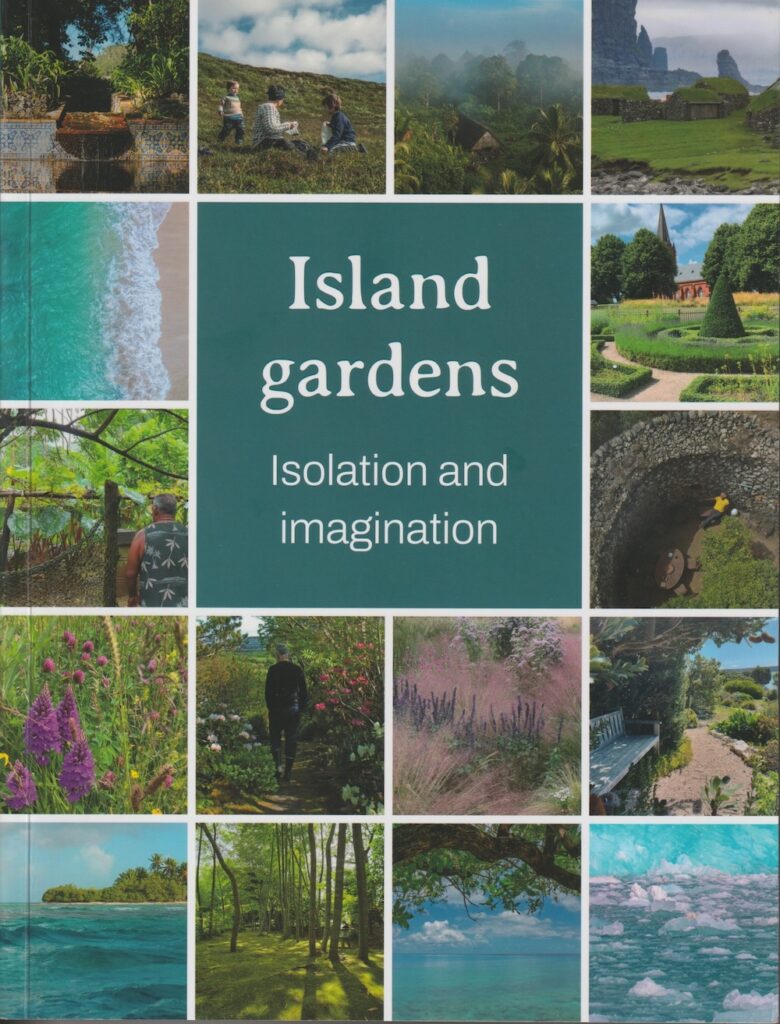
Forty-two chapters, and over seventy authors with section headings:
- Gardens, identity, culture & change
- Gardening and community: Reciprocity and connection
- Impossible gardens: Ingenuity and oersistence
- Coalescence: Gardens as assemblages of personal and cultural journeys
- Gardens in time: Memory, preservation, rediscovery and loss
- Gardens for solace and sanctuartu
- Oases: Islands as gardens, gardens as islands
- Reflections
2024 CHAPTER: ‘Inheriting Isotopes: the Androcene and the End of Nature in the Great Victoria Desert A-Bomb Test Sites.’ Desertscapes in the Global South and Beyond: Anthropocene Naturecultures, eds. Sushila Shekhawat, Rayson K. Alex, Swarnalatha Rangatajan. Routledge (pp. 27-45). DOI: 10.4324/9781003280774-4 https://hdl.handle.net/102.100.100/661258
ABSTRACT: ‘The “Great Victoria Desert, arid wasteland in southern Australia” declares Encyclopaedia Britannica (2021). ‘Wasteland’ better describes desertification; the British perspective is at odds with an indigenous outlook moulded by fragile ecosystems inscribed by sacred spaces and centuries of inhabitation. Nevertheless, during the Cold War, British Boosterism and Commonwealth Cringe positioned the Enlisted and the Overlooked as observers of British A-bomb testing thereby transforming Maralinga in the Great Victoria Desert into nuclear wasteland. Those present experienced their own transformation as radioactive fallout reshaped future generations. Bill McKibben’s declaration that the ‘Anthropocene’ marks the ‘end of nature’ prefaces Timothy Morton’s take that humans are no longer ‘natural’ – the dumping of radioactive material on two Japanese cities during WW2 ended ‘nature’. Radioactive fallout coated the Earth’s crust with fission isotopes including Strontium-90, a man-made, biologically hazardous product. The ‘end of nature’ intensifies in the local of the Great Victoria Desert, home of Anangu, where arguably ‘homo sapien’ became ‘homo strontium’, composed of, altered by, and living within a world imbued with human-made strontium-90. Pre-Anthropocene narratives from key players in the desert imaginary of the British (T.E. Lawrence; Gertrude Bell; E.M. Hull; Simon Mawer) are, in this chapter, configured as increasingly violent Double Helix entanglements that are synchronised with contemporaneous narratives from the Great Victoria Desert (Charles Duguid; Daisy Bell; Judy Nunn). Following Timothy Morton’s notion of hyperobjects, the essay narrativises the backstories behind chemical and chromosomal fallout on Black and White Australia.
KEYWORDS: Anthropocene; Ecocriticism; Great Victoria Desert; Anangu; British Government A-bomb tests; Maralinga; William Penney; Hedley Marston; strontium-90; DNA; natureculture representations of Arabian, Algerian, Australian Deserts; T.E. Lawrence; Gertrude Bell; E.M. Hull; Charles Duguid; Daisy Bates; Judy Nunn; Simon Mawer; Australian TV and Film.
JOURNAL ARTICLE: ‘The Zwergroman: Literary Dwarfs under the Australian Gaze.’ Antipodes, vol. 36, no. 1, 2022, pp. 78-93. https://muse.jhu.edu/issue/4962

ABSTRACT: Dwarfism’s connection with Australia’s mythic and literary history is remarkable enough to suggest here that it occupy its own subgenre in literature, the zwergroman (m.) zwergeroman (f.). Australia’s branding as the “Antipodes” geographically recalls its colonial past; mythographically the imaginative configuration was as an underworld of opposites ruled by the diminutive King of the Antipodes (Loomis 110). Thus, the zwergroman is frequently fashioned from the Celtic myths of the colonising power along with the shaping power of colonial processes.
The authors of these zwergromans were able-bodied at the time of writing, excepting Patrick White. They include C. J. Koch, The Year of Living Dangerously (1978; filmed 1982); James McQueen, Hook’s Mountain (1982); Ruth Park, Swords and Crowns and Rings (1977); Peter Carey, The Unusual Life of Tristan Smith (1994), and Patrick White, The Vivisector (1970). Dwarfs as minor characters and as represented in earlier writings by these authors are considered for their role in supporting or stigmatising short stature, the Australian term for dwarfism (Short Statured People of Australia). Discussion of female able-bodied characters (Jill Bryant, Ellen Carter, and Cushie Moy), though of narrative significance, is omitted in the interest of brevity and this study’s focus.
https://hdl.handle.net/102.100.100/601750
2020 “Reconstructing Representations: ‘Australia’ as Ecocritical Andragogy.” Ecocritical Concerns and the Australian Continent, edited by Beate Neumeier and Helen Tiffin. (Ecocritical Theory and Practice Series, Rowan & Littlefield International). DOI: 10.4324/9781315167343-4
”Cranston’s chapter, which is by far the longest in the volume (even taking into account its lengthier bibliography and its inclusion of illustrations), rightfully occupies a central place in the book. Although it is set in the “colonial arts section,” it offers a fast-paced and thought-provoking exploration of how the “Two Cultures” of the humanities and science must collaborate to guide humanity towards a truly ecological world-view. Drawing from a wide field of representations, namely historical travel writing, the fine arts, film, fiction (from highbrow writing by Patrick White, Murray Bail, and Alexis Wright to cli-fi by Gabrielle Lord), Cranston usefully explores the divergence between biocentric (concerned only with the animate world) and ecocentric approaches, and signals how the latter, which grants humans and non-humans no special importance beside the way they influence the ecosystem, is “guaranteed to antagonize postcolonial feminists, especially third-world women of colour,” as well as “Animal Rights advocates”‘. (Anne Le Guellec-Minel, Commonwealth Essays and Studies 44.2, 2022, p.173)
Chapter includes a specific focus on climate change through the work of SA artist, Hans Heysen; Patrick White’s Voss, and Gabrielle Lord’s cli-fi Salt, while demonstrating ecocritical methodologies.
2020 ‘Guest Editor’s Note’, Tamkang Review, Special Edition ‘Australasian Ecocriticism”. Editor-in-Chief: Iris Ralph. Vol. 51, No. 1, Dec. 2020, pp. i-xii Tamkang University Press, Taiwan.
URL (Proofing copy): https://ca-cranston.com/wp-content/uploads/2026/08/Tamkang_Review_Guest-Editors-Note-2019_first-proof.pdf

2019 “Eco churches, Eco Synagogues, Eco Hollywood: 21st-Century Responses to Lynn White, Jr.’s and Andrew Furman’s 20th-Century Readings of Environments in Crisis” in Ecocriticism and Environmental Communication, Routledge, S. Slovic, S. Rangaranjan, V. Sareswaran (eds), New York, pp. 36-54. https://hdle.net/102.100.100/711368 (Paste into UTas figshare page)
ABSTRACT:
Lynn White, Jr.’s critique of the “dogma of creation, which is found in the first clause of all the Creeds” (1942: 156) prompts examination of sacred and semi-historical ecocritical texts, and acts as a crucial demarcation between 20th century thinking and theological finger-pointing and 21stcentury action, with the rise of eco churches and eco churches and synagogues delivering practical responses to environmental crises. Methodology includes two case studies demonstrating eco theology in action. These include the recently-established (2015) Tahlee Centre for creation care, in NSW, Australia; and Finchley Progressive Synagogue, in London, one of four London synagogues piggy-backing on the eco church program and broadening the tikkun olum (‘repairing the world’) concept from a social, to an ecological view, of a world in crisis.
The third section moves beyond church or synagogue and away from text to the imaginative terrain of cinematography in the USA; it notes media critic Phil Hoad’s comment that Hollywood — “loyal to its eco-sceptic audiences in middle America — has always been frosty towards environmental movies” (2011). Films discussed include: Soylent Green (1973), Jaws (1975), The Lion King (1994), Finding Nemo (2003), Madagascar (2005), and An Inconvenient Truth (2006).
‘CA.Cranston’s [chapter] startling for the subtlety and nuance of the thinking, moves comfortably among Judaic concept–such as the mitzvah of tzedakah (צדקה) on the one hand, and ‘real-world influence’ (49) on the other–and both summarises a great deal of material and adds significantly to existing research‘ (Simon Estok, Green Letters, p. 229).
2017 ‘Climate and Culture in Australia and New Zealand‘ with Charles Dawson (NZ). A Cambridge Global History of Literature and the Environment, edited by Louise Westling and John Parham, CUP. pp. 237-254). ISBN: 978131621257 http://ecite.utas.edu.au/112914 KEYWORDS:Australian Literature; New Zealand Literature; Oceania; Climate Change; Colonisation; Eutrophication and the Anthropocene.
Section headings include ‘Climate Change and Extinction’; ‘Climate and Colonisation’; ‘Nationalizing Climate Tropes: Burning and Felling the Landscape’; Demonizing, and re-valuing the Land’; ‘1970s: “Climate and Culture” Eutrophication and the Anthropocene’; 1980s: Social Darwinism in a Flooded Landscape’; ‘1990s: Salt: Self as Prey in a Sterile Landscape’; ‘”Singing Up Country (Despite the Anthropocene)”‘; ‘Aotearoa New Zealnd: “We Oceanians”?’ ‘Foretellings’.
2012 ‘An Ecocritical Reading of Aravind Adiga’s The White Tiger’. Contemporary Contemplations of Ecoliterature, edited by Suresh Frederick. New Delhi: Authors Press, pp. 228-266.
[Name published erroneously as C.A. Caranston, “An Ecocritical Reading of Aravind Adiga’s The White Tiger”]. (pp. 229-266)) https://hdl.handle.net/102.100.100/535119

LITERARY ECOCRITICISM TEACHING RESOURCE: This chapter, with close to 3000 downloads, demonstrates the application of ecocritical methodologies , both Western and Tamil.
KEYWORDS: Australian Literature; Tamil Literature; Ecocriticism; Cankam Literature; Intertextuality; DDT, Forest Clearances, Tiger habitat.
‘[Balram] begins to drink like his master; he attempts to fornicate like his master. He reads – not Murder Weekly – but the literature of ideas. He notes that “It’s when your driver starts to read about Gandhi and the Buddha that it’s time to wet your pants, Mr Jiaboa” (126). He begins to disapprove of his master,; an attempt to frame him for the death of a pedestrian, which includes false testimony by Granny Kusum, results in the destabilizing of Balram’s moral centre. He begins to consume his monster; he reverses the order of predator and prey’. (Source: Cranston 2012: 256)
2009 “Literary Ecoconsciousness” in Reading Down Under: Australian Literary Studies Reader, edited by Amit Sarwal and Reema Sarwal. New Delhi: SSS Publications, pp. 379-385. ISBN No. 81-902282-1-0
2009 ‘From Shanty to Shanti: Teaching Australian Literature in India’ in ‘Special issue: Australian Literature in a Global World’, JASAL Vol. 9, pp. 1-14. http://www.nla.gov.au/openpublish/index.php/jasal/index (Paste in browser)
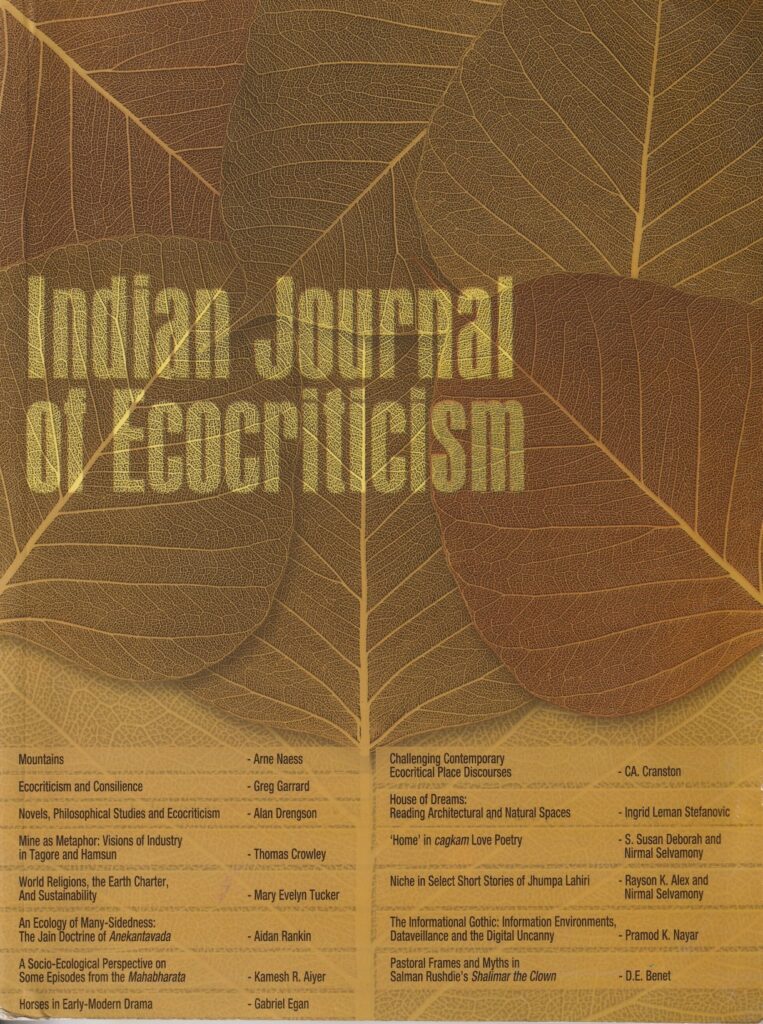
2009 “Challenging Contemporary Ecocritical Place Discourses: Military Brats, Shadow Places, and Homeplace Consumerism” Indian Journal of Ecocriticism. Vol. 2, pp. 72-89. Military and Feminism: An eco-autoethnographic account of growing up in military postings (‘Third Culture Kids’); and examining the ecological costs of what Val Plumwood refers to as ‘The One True Place’ https://hdl.handle.net/102.100.100/492473
Abstract: ”I have become a queer mixture of the East and West, out of place everywhere, at home nowhere‚‘ (Nehru qtd. In Young 348). Nehru’s difficulty in situating himself in place was a problem of circumstance. He lived at the time when the East was in the process of divesting itself (with Nehru’s help) of the West (i.e., Britain). And yet Nehru’s 20th century narrative of (very real) upheaval and (very real) dislocation is rendered as he says out of place‚ particularly when compared to current accounts of habituation and continuity, where settlement and stability are the preferred images of place in an increasingly unsettled, unstable economic and ecology-depleted world. This essay began as a lament to the elusive One True Place; it turned into a cry for alternative narratives of place – narratives that recognise the inhabitants of the Everywhere and Nowhere camp – where following the global shake-up of decolonisation, the legacy bequeathed millions of Military Brats is disempowerment and displacement. This investigation into the ways in which particular (coloniser) histories and (colonised) geographies, situated within an economic framework, can work for or against a mobile, military dependent’s quest for the rhetorical carrot known as the ‘One True Place’ and finds an odd bedfellow within the terms set out in Val Plumwood’s essay, Shadow Places and the Politics of Dwelling (2008). KEYWORDS: Ecocriticism; Place-based habituation; British Colonialism; Val Plumwood; feminism; Third Culture Kids aka Military Brats.
2008 ‘Wet, in the Mindscape of the Dry‘ in Words on Water: Literary and Cultural Representations, edited by Maureen Devine and Christa Grewe-Volpp. Wissenschaftliche Verlag Trier: Germany, pp. 228-266. https://hdl.handle.net/102.100.100/490677
ABSTRACT: While the island continent of Australia engages in the geographical reality of water excess – ocean surrounds and endless beaches – the literary constructions of “Australia” move inland, to the outback, where landscape forms the mindscape of the Dry. It (‘Dry’) is an image of Australia that participates in a literary celebration of waterlessness, an endorsement of a particular natural resource scarcity that has seeped into the public imagination, and impinged on community values, and consequently on attitudes towards water harvesting.Literary representations of waterlessness create an image of ‘Australia’ which conflates outback characteristics of drought with rural characteristics of Australian ‘toughness’. The works of Henry Lawson, Dorotha MacKellar, Jack Hibbard, Les Murray, John Kinsela, Oodgeroo Noonuccal, Richard Flanagan and Nicholas Jose are discussed along with images from popular culture (newspapers and television advertising).
KEYWORDS: Water Harvesting; water tanks; corrugated iron architecture; environmentalism; migrants; Australian writers.
LITERARY ECOCRITICISM TEACHING RESOURCE: The chapter ‘Wet, in the Mindscape of the Dry’ in Words on Water provides a teaching resource demonstrating an ecocritical reading of Jack Hibberd’s A Stretch of the Imagination and WW2 immigrant responses to Australia’s vernacular building material, corrugated iron.
2007 BOOK: The Littoral Zone: Australian Contexts and their Writers, edited by CA. Cranston and Robert Zeller. Amsterdam & New York: Rodopi, 319 pages [Ecocriticism]
‘In this, the first collection of ecocritical essays devoted to Australian contexts and their writers, Australian and US scholars explore the transliteration of land and sea thought the works of Australian authors and through their own experiences‘. Back Cover
2007 ‘Setting the Scene: Littoral and Critical Contexts’. Robert Zeller and CA. Cranston, in The Littoral Zone: Australian Contexts and their Writers: Ecocriticism. Amsterdam & New York: Rodopi, pp. 7-30.
https://hdl.handle.net/102.100.100/490677
2007 ‘Islands’, in The Littoral Zone: Australian Contexts and their Writers, edited by CA. Cranston and Robert Zeller, Amsterdam: Rodopi, pp. 219-260). http://eprints.utas.edu.au/4749/
2004 Chapter, “C.J. Koch (1932-).” Dictionary of Literary Biography, Volume Two Eighty Nine: Australian Writers, 1950-1975, edited by Selina Samuels. Bruccoli Clark Layman, pp. 196-206. https://hdl.handle.net/102.100.100/490647
2003 “Rambling in Overdrive.” (Ecocriticism). Tasmanian Historical Studies 8 (2 ): 28-39. https://hdl.handle.net/102.100.100/494213
2002 Chapter, “John Morrison”. Dictionary of Literary Biography Volume Two Hundred Sixty: Australian Writers, 1915-1950, edited by Selina Samuels. Bruccoli Clark Layman, pp. 239-249. https://hdl.handle.net/102.100.100/490633
2001 Australian Literature Gateway and Scholarly Electronic Text and Image Service (SETIS citation 14:2) e-published “Sentimental Jonah’s Heart of Stone”. Originally published in Australian Literary Studies, 14 (October 1989): 216-228.
2001 “Tasmanian Nature Writing and Ecocriticism”. Special issue. Australian Literary Studies in the 21st Century, edited by Philip Mead. ASAL: Hobart, pp. 59-67. https://hdl.handle.net/102.100.100/494259
ARCHIVES for work before 2001 currently under construction
1