The 1989 and 1991 publications (below) concern representations of disability in Australian literature; they precede the thematic and theoretical area known as Disability Studies, which has blossomed textually and in the real world in a climate of inclusivity. The term ‘deformity’ (as used in 1989, and in the 1991 PhD thesis) was used at that time in preference to ‘disability’: investigation into representations of fictional and factual characters (such as Alan Marshall and Lex Banning) found characters to be very ‘able’. As ‘Disability Studies’ indicates, the currently preferred term is ‘disability.’ The publications (2022, and 2023 (body-ecology entanglements)) follow the currently accepted terminology.
‘Sentimental Jonah’s Heart of Stone.’ Australian Literary Studies (ALS), Oct. 1989, Vol. 14, No. 2, pp. 216-228. https://ca-cranston.com/wp-content/uploads/2021/01/Sentimental-Jonahs-Heart-of-Stone.pdf
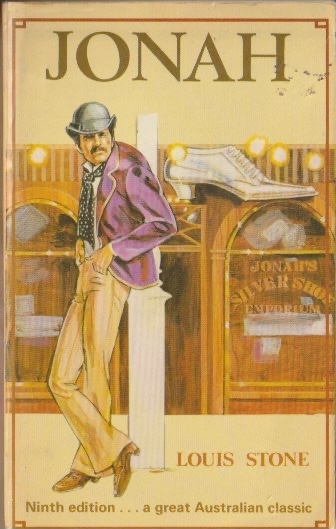
‘Through the overt association with the mythological Pan, Stone’s conscious choice of a hunchback ‘hero’ presupposes the atavistic response inspired by the Myth of Deformity [that] The deformed body is a semiotic system of the irrational; it manifests itself in an easily identifiable form: disability defines an identity determined by persona. Underlying this mask of deformity is the assumption that spirit and body are of a oneness, a wholeness, of synchronous distortion’
(Cranston, ALS , 1989, p. 217)
‘The Zwergroman: Literary Dwarfs under the Australian Gaze.’ Antipodes, vol. 36, no. 1, 2022, pp. 78-93. https://muse.jhu.edu/issue/49627
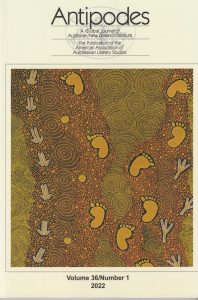
ABSTRACT: Dwarfism’s connection with Australia’s mythic and literary history is remarkable enough to suggest here that it occupy its own subgenre in literature, the zwergroman (m.), zwergeroman (f.). Australia’s branding as the “Antipodes” geographically recalls its colonial past; mythographically the imaginative configuration was as an underworld of opposites ruled by the diminutive King of the Antipodes (Loomis 110). Thus, the zwergroman is frequently fashioned from the Celtic myths of the colonizing power along with the shaping power of colonial processes.
The authors of these zwergromans were able-bodied at the time of writing, excepting Patrick White. They include C. J. Koch, The Year of Living Dangerously (1978; filmed 1982); James McQueen, Hook’s Mountain (1982); Ruth Park, Swords and Crowns and Rings (1977); Peter Carey, The Unusual Life of Tristan Smith (1994), and Patrick White, The Vivisector (1970). Dwarfs as minor characters and as represented in earlier writings by these authors are considered for their role in supporting or stigmatising short stature, the Australian term for dwarfism (Short Statured People of Australia). Discussion of female able-bodied characters (Jill Bryant, Ellen Carter, and Cushie Moy), though of narrative significance, is omitted in the interest of brevity and this study’s focus.
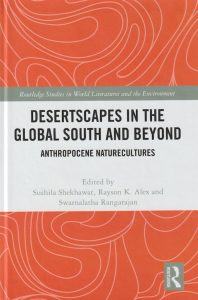
2024: ‘Inheriting Isotopes: the Androcene and the End of Nature in the Great Victoria Desert A-Bomb Test Sites.‘ Desertscapes in the Global South and Beyond: Anthropocene Naturecultures, eds. Sushila Shekhawat, Rayson k. Alex, Swarnalatha Rangorajan. Routledge.
KEYWORDS: Anthropocene; Ecocriticism; Great Victoria Desert; Anangu; British Government A-bomb tests; Maralinga; William Penney; Hedley Marston; strontium-90; DNA; natureculture representations of Arabian, Algerian, Australian Deserts; T.E. Lawrence; Gertrude Bell; E.M. Hull; Simon Mawer; Charles Duguid; Daisy Bates; Judy Nunn; Australian TV and Film.
ABSTRACT: ‘The “Great Victoria Desert, arid wasteland in southern Australia”’ declares Encyclopaedia Britannica (2021).
British attitudes towards the Australian desert suggests a confirmation bias of Australia’s terra nullius (‘Nobody’s land’). Add the idea of an ’empty’ desert to Britain’s previous imperial and Empirical encounters in the populated deserts of Arabia and Algeria during WW1. Pre-Anthropocene narratives from key players in the desert imaginary of the British (T.E. Lawrence; Gertrude Bell; E.M. Hull; Simon Mawer) are, in this chapter, configured as increasingly violent Double Helix entanglements that are synchronised with contemporaneous narratives from the Great Victoria Desert (Charles Duguid; Daisy Bell; Judy Nunn). Following Timothy Morton’s notion of hyperobjects, the essay narrativizes the backstories behind chemical and chromosomal fallout on Black and White Australia. where arguably ‘homo sapien’ became ‘homo strontium’, composed of, altered by, and living within a world imbued with human-made strontium-90.
Deformity as Device in the Twentieth Century Australian Novel. 1991. University of Tasmania, PhD
Downloadable here.
Some Australian Book covers from pre-digital Disability and Mad Studies research projects


